
On Dating Platforms & Selection
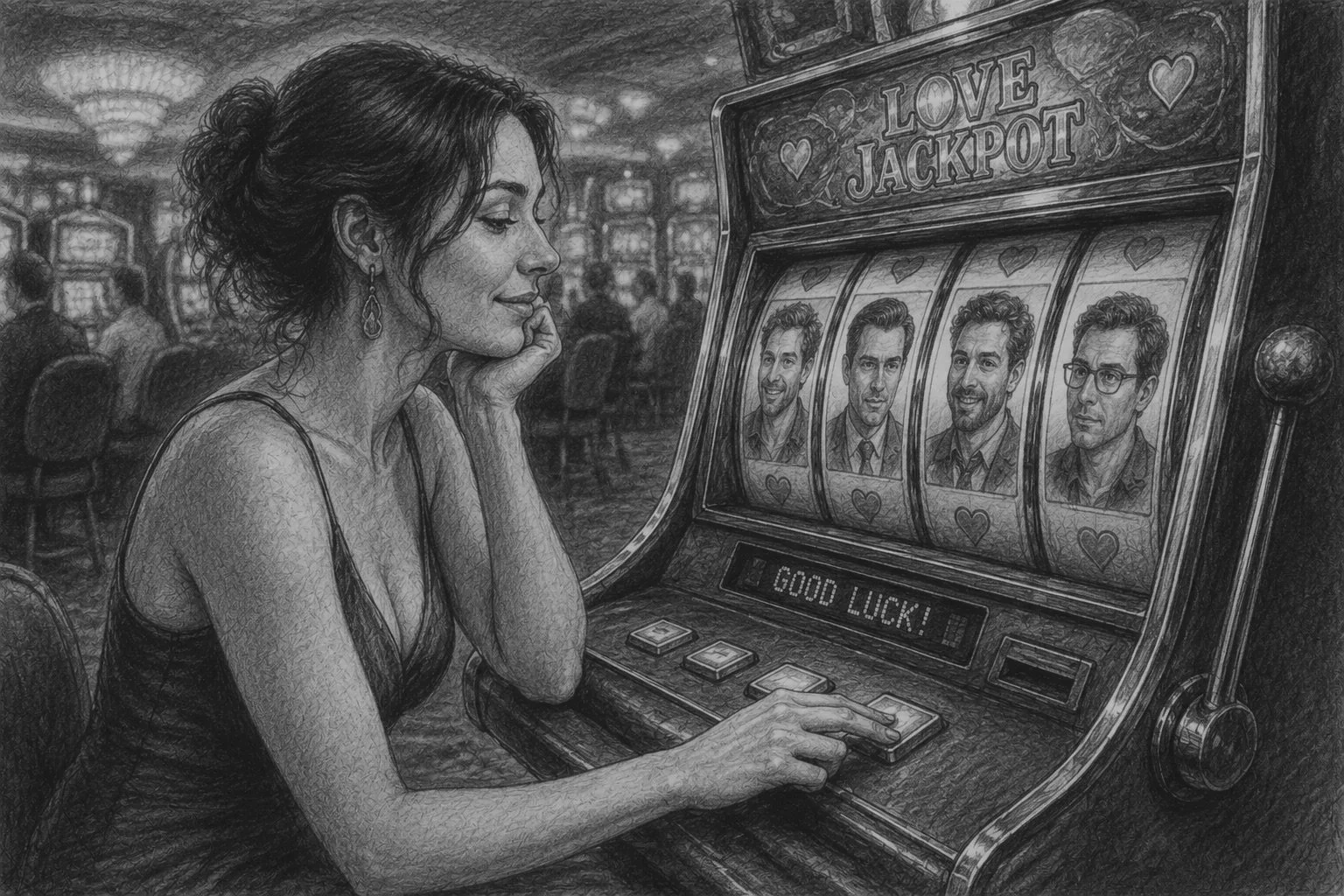
To have and to hold, and to spin, spin spin.
I don’t remember what in Maya’s profile on Feeld made her stand out to me. Quite often, with men outnumbering women 10 to 1 on dating apps, we will swipe right on girls that we wouldn’t place as our typical pool, but vet them once a match has happened or early in the direct chat stage. When it comes to guys, I don’t browse for them on apps but if one from other walks of life shows an interest in me then I’m up for setting a date to explore further. Similarly if a fella comes attached to a lady I connect with then it’s a free for all so long as he’s comfortable with it. We have a term for that; it’s called heteroflexibility, and it falls within the queer macroset [See — On Sexual Orientation].
When it comes to text chatting, I tend to wait until my matches ‘open’ me — ‘approach and speak first’ in pick-up-artistry talk. Prioritising the ones that open is a surefire way to make sure that I’m dealing with someone who is enthusiastic [See — On Attraction]. Plus, as we all found out during our schooldays, the basics of playground romance psychology teaches us that finding out that someone fancies you suddenly adds +40 points to their attractiveness score.
My future discarder did message me first, and I let her into my life. I don’t remember what she said, but so long as she wanted to meet without too much back and forth and didn’t ask for a high energy or high cost first date such as a club or 4 course dinner at Sexy Fish, then I would have been up for buying her a meal and a few drinks. I would have taken her as far as she wanted to go regarding sex. On Feeld, nearly all guys are immediately down for sex, and if the girls have reached sex-emotion liberation then they will be too unless there is a last minute ick [See — On Sex Positivity, Liberation, & Enlightenment].
I tend to only use Tinder when romantically single and not when in an open relationship because it can take some awkward explaining to bring matches up to speed with my situation. And again I’d prefer for them to initiate so that I know that they are enthusiastically interested. It’s a time management thing.
Dating Platform Usage
Match Group owns over 40 dating platforms including tinder, match.com, Hinge, POK, OKC, and The League, an invite only or 100k+ insta followers exclusive platform. Bumble owns Badoo, and Her, Thursday, Happn, and Coffee Meets Bagel are all independent.
Pew Research Center says that 30% of Americans have used a dating platform, and 360 million log on worldwide, but for the reclusive gay or straight male, such environments are make-or-break regarding companionship, since if Proceedings of the National Academy of Sciences’s data is to be followed till death do us part, 60% of American marrying couples met online. so the first and last arena where lie realistic probabilities of organising a meet up.
Swipestat’s research showed straight women swipe left (that means ‘pass’… grandad) on 95% of profiles they see, while men pass on 47%. So guys in that 95% should adopt an approach of regarding such apps as auxiliary aids to a healthily ebbing and flowing list of acquaintances.
Usage Patterns & Learnings
Christian Rudder, founder of OK-Cupid, showed in Dataclysm (2014) that if straight women choose men based on looks, the preferred model is older the older that the woman is. In fact the trend is fairly linear in correlation with their own age. For example, 20-year-old women prefer the look of 23-year-old men and 45-year-old women pick out 40-year-old men the most. But when straight men are shown pictures of women, they consistently choose the youngest models available. Taraban references another study that showed that when men from all ages are shown pictures of women and asked which they would like to make long term partners out of, the average age of the preferred women is 24. When women of all ages are asked the same of men they chose men at the age of 40.
It’s no secret that apps push the most active, closest, and most attractive, and highest paying users to the top of the ‘deck’ when browsing. And it’s similarly well known that in this very visual medium, looks are king, and so good-looking people might consist of the top 5% of users and they get matches with 90% of the intended target group. This is unfortunate for straight men especially since I’ve heard that women who met men in real life that they swiped left on on the apps have a newfound attraction to them saying “I never would have swiped right”.
It also still stands that relationships that are started offline, perhaps through friends and work and hobbies and chance encounters statistically last longer than online meet-cutes. This is because we are more attracted to people who are involved in the spaces that we are involved in and we get to see them in their element which is one of the 3 main attractors mid relationship according to Esther Perel. The next attractor is absence from our partner. The last of the trio is in witnessing other people express desire for our partner as observed in a speed dating study in 2010; this is known as mate copying and has been widely documented in many animal species, mostly birds.
Dating platforms are also somewhat gamified with the words, sounds and visualisations that decorate video entertainment. Some of the women, and I’m told some of the men on Grindr, not unlike videogames, are Pay to Play. and some are Pay to Win.
Dating platforms have become a space to display preferences or even kinks without even naming or showing yourself and certainly not in a town messageboard type way. Preferences might include gender, age, race and class. And kinks are being accommodated-for in bios in platforms such as Feeld.
Feeld and others
Feeld launched in 2014 as 3ndr but was sued after 2 years by Match Group for having a derivative name. This only served to increase the profile of the dating platform which pitched itself as Tinder for 3somes. Users are able, as on other platforms, to set their profiles as having a gender, including MM couple, FF couple, MF couple, trans M, trans F, and more. Users set their search options from the same list. Users list their kinks such as threesomes, foursomes, moresomes, bondage, dominating, being dommed, impact play, orgasm denial, anything really. Then users can set their search based on those kinks.
The cities with the highest number of users are London, San Francisco, Berlin, Amsterdam, Austin, Barcelona, NYC, Portland, Sao Paulo, Seattle, and Copenhagen, which is a match for places with more liberal values.
As the same account can be accessed from 2+ devices, couples profiles can be managed by both members of the couple. And up to 5 profiles can be visibly mutually linked with a tag like ‘primary partner’, ‘dom’, ‘sub’, etc to provide verification and depth to the person(s) one is looking at. Where there is the possibility to verify that you are real by submitting a selfie to the admins, many choose not to show their faces in their profiles due to their sexuality being outed being a risk to their familial and/or professional life. But once chatting it is possible to send single view pictures. In a similar app, WeAreX — which started as Killing Kittens’s original social media platform but expanded to include Torture Garden, Fox & Badge, and HE SHE THEY — there’s the possibility of vouching for connections to show that they are real and decent. And it’s possible to link the results from a few recognised sexual health test providers to display negatives on one’s profile, and by negatives I mean positive news.
The community around Feeld is strong, although an observed seasonality of the adoption of the platform, and the periodic influx of technically sexually liberated but un-inducted lads have meant that user-user vetting has moved to in-person socials. For a public forum, with mass-marketing, comes mass awareness and that threatens with dilution the thing that made it so appealing for early-adopters.
Choosing a broker
A bit like deciding which resale marketplace (ebay or facebook perhaps) or job marketplace (indeed or linkedin maybe) to join, picking an online dating platform is based on deciding where your target buyer is, and perhaps hedging your bets by subscribing to more than one. From that point on, it just involves a bit of admin, and optimisation, and fighting the inevitable cringes when you match with the same person on more than one platform.
At the turn of the millennium, OK-Cupid and Plenty of Fish led the freemium model of dating platforms. eHarmony and match.com were more premium. Users had to invest in writing their bios more fully than, for example, Tinder which revolutionised dating controversially by being more looks-first.
Sex-first dating platforms are odd in the way that the buyer-seller dynamic is somewhat reversed. Orion Taraban’s work The Value of Others (2024) uses a book-long analogy of the male captain advertising tickets to female passengers on his life voyage. In the hetero strictly-sexual marketplace however it is often the men that are queuing at the dock, and not just because men outnumber women 2 to 1 on most platforms according to a study by SwipeStats, although it used to be much higher.
Choosing a mate
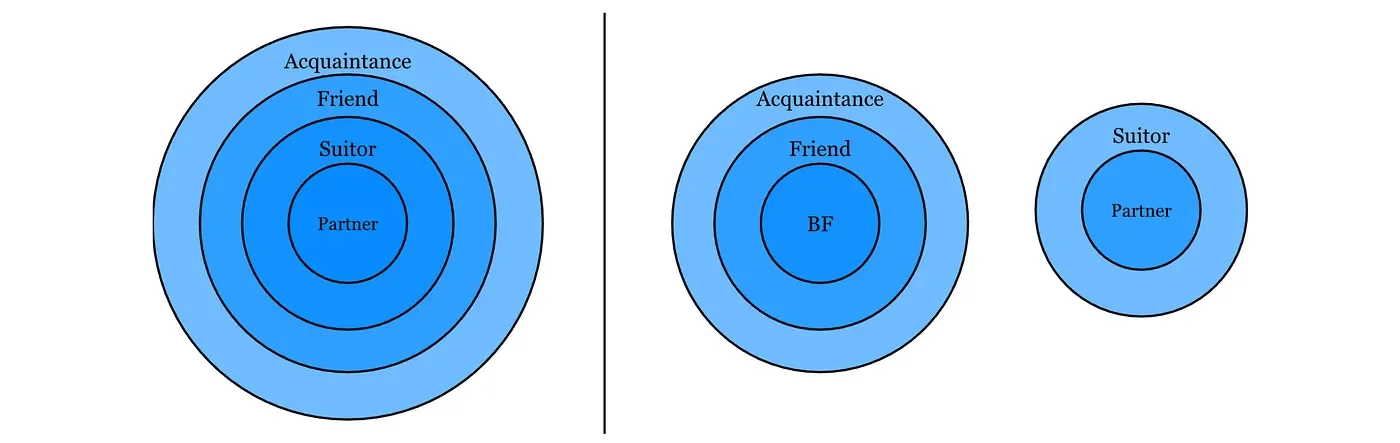
So for many, they are way to expand the circle of friends; in fact when people ask what we users are looking for, and we suspect that to say ‘sex please’ is a trap, We might subvert the expectations and say “the same in any interaction, a new perspective, a new friend in whom I can invest as much as they invest in me and if things develop then we see more and more of each other. And if we are comfortable being physical then that’s a nice adult bonus. And if we are both romantically uninvolved then we can explore that too.” There’s a philosophy of concentric escalations which says that a partner must by definition be a friend first, even if just for a few hours, before escalating them to suitor, meaning being open to courtship aka dating (spending time with the view to explore romance). This model posits that Bumble Dating should not be a parallel product to Bumble for Friends but an embedded level of escalation within it:
The infinite scroll logic that governs social media, which itself borrowed from the slot machine, has been imported wholesale into the romantic marketplace. With it comes the illusion of infinite supply. When the next candidate is always one swipe away, people begin to treat potential partners as items in a catalogue that is only fractionally explored.
An additional layer of psychology applies, highlighted by Psychologist Barry Schwartz. The more options available, the less confident we become with our ‘choice’, not being able to score all 20+ options in a sort of Option Paralysis. Some platforms like Once and Hinge have features designed to combat that with curated ‘most compatible’s and 1 match per day offerings.
These patterns in combination with a general loss of social skills as reported by the global Mental Health Million Project at Sapien Labs which found that how an individual views themselves in relation to others and navigates social interactions has declined continuously with each subsequent generation, has meant that there’s a correction occuring regarding re-adoption of the old norm of fishing for a date within one’s group of buddies. Younger daters in particular are reportedly returning to their social circles as the preferred theatre for romantic exploration. It’s one to watch. India may be onto something with it’s prolific matchmaking services. Whether we are using a broker or not, what do we need to understand about the battleground of buyers and sellers?
The Sexual Marketplace
The economy of attraction is as broad as it is deep, so let’s narrow it down to at least look at the somewhat less sexy term, ‘mate selection’.
A 1995 study by Anthropologists David Waynforth and Robin Dunbar analysed “Lonely Hearts” ads in American newspapers to compare evolutionary theories of straight human mate selection. Female posters tended to describe their physical attractiveness and indicators of youth while seeking prospective mates who could provide resources and commitment. Male posters primarily emphasised their resources, intelligence, and ambition, while seeking women who offered youth and physical attractiveness. These mate-choice patterns reflect evolutionary principles; they suggest that humans tend to advertise traits that highlight their physiological reproductive value or parental investment capabilities.
The 2 professors also directly connected heterosexuals’ self-image to the degree to which they believe they offer what the opposite sex desires, namely physical beauty or resources. They established that prospective mate viability minimums are linked to that self-image, meaning individuals enter the romance marketplace with a self-bestowed grading of premium-ness, and adjust their standards accordingly. Females who openly offered cues of physical attractiveness held a higher self-concept of their bargaining hand and consequently made significantly higher demands regarding a potential partner’s traits than those who did not view themselves as attractive. Males from higher socio-economic backgrounds, or those offering substantial resource cues, operated with an elevated sense of market worth.
When an individual’s self-image drops because of physical injury or emotional trauma or a protracting length of time on the market, people adjust their ‘bargaining hand’ downward, leading to a widening of the net, meaning a reduction in incoming selectivity. Evolutionary value is tied to reproductive fitness. A women’s self-advertised bargaining power typically declines with age, prompting them to become less demanding over time. Conversely, material resources often increase with age, causing older men to become more picky. Individuals with a lower self-image actively look for alternative ways to market themselves, such as shifting their focus to advertising any of the myriad other values that human beings can have and display.
In their foundational 2003 study published in the Proceedings of the National Academy of Sciences, researchers Peter Buston and Stephen Emlen tested people’s desire for matching traits. They discovered that modern Western daters do not heavily seek to cross-trade different traits in which they are lacking (e.g., a wealthy but less attractive man seeking a highly attractive but less wealthy woman). Instead, human mate preference is governed by a desire for homophily, meaning people subconsciously search for a partner who mirrors their own specific strengths. They grouped evolutionary mating attributes into 4 categories of wealth or status, family commitment, physical appearance, and sexual fidelity. They found that for men as much as women and for each sexual orientation, self-perception in one distinct category directly predicted how picky they were within that same category.
So a balance of differences that we can tolerate and life goals and values that have timelines that align seems to be the oversimplified capture zone — where we should be looking for a partner. But I have other articles about that.
What science tells us about the perfect dating profile
Data compiled from large-scale studies by online dating platforms alongside formal social psychology research shows exactly how specific profile features influence matching outcomes. What works optimally varies noticeably by gender. The findings are as follows:
Leading with a group shot is heavily penalised. Daters swipe rapidly and find it frustrating when they cannot immediately identify who owns the profile. The “Cheerleader Effect”, popularised by the sitcom How I Met Your Mother (2005) and later scientifically validated in studies by psychologists Drew Walker and Edward Vul, describes how the ugliest person in a group appears more attractive and vice versa because the onlookers’ brains average out the group’s beauty, rather than lock-on to and emphasise the difference between them. Polite attempts at identity protection by cropping friends out is also a major turn-off as it implies deception and lack of ability to take similar flattering photos solo. A group photo also makes the single person look less single but can help if it shows them in a high-status or warm social role. For example, a Psychology Today analysis highlights that photos of individuals acting as bridesmaids or groomsmen serve as strong signals of social standing and reverence towards relationships.
The verdict on Full-Body Shots vs. Close-Ups is in. Including at least one full-body shot yields a massive 203% boost in messages received for both genders. Profiles that only utilise close-up headshots spark algorithmic suspicion that the user is actively hiding their build and posture. Full-body shots are especially critical for men, since women look closely at height too. But also for ladies, close-up photos emphasising facial features, a genuine smile, and clear eye contact generally drive their highest initial swipe volume.
I’m not one to say that women should stay inside, but the stats on dating profiles do! Men see an 18% increase in incoming messages when their photos are set outdoors. Images of hiking, traveling, or in natural settings project evolutionary signals of ruggedness, health, and high physical activity. Indoor shots especially in bedrooms or bathrooms frequently perform poorly for males. The stats are worse for selfies, and worse still for mirror selfies. Surprisingly, women experience a 40% to 60% increase in engagement with high-quality photos shot indoors compared to outdoors. Data indicates that controlled indoor environments allow for warmer, flattering lighting and softer focus. This highlights facial clarity over harsh, bright outdoor sunlight.
So to cap it off, here is the recommended 5-pic gallery for impact:
Photo 1: Clear, well-lit headshot, looking at camera, genuine smile.
Photo 2: Full-body action shot, outdoors for men, relaxed/social for women
Photo 3: Lifestyle/Hobby shot showing personality or a specific talent/passion
Photo 4: Smart/Formal shot high-quality attire suit or long dress.
Photo 5: Group shot.
This is powerful information. Use it wisely.
