
On Groundless De-escalation
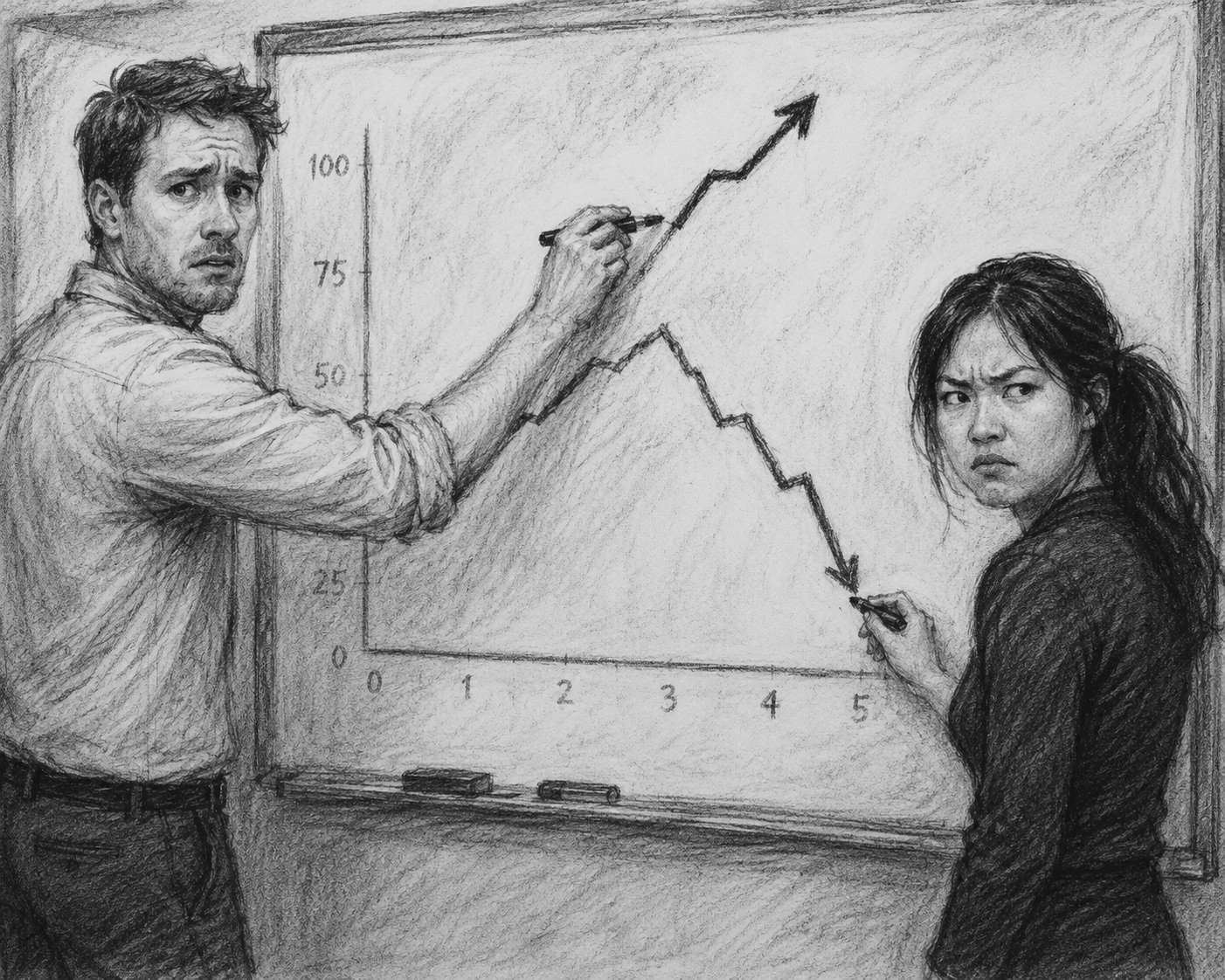
She said I spoke about my break up with Eolanda too much
When Amber left me in the Stansted Radisson that Christmas Eve morning, she was as cold as the winter that was setting in. Then 2 weeks later came the textual extrication. And the resulting relationship was akin to mild acquaintances, not 2 people who’d shared so much from the heart and from the loins. I get it, but also I can’t bear the distance. I started to wonder if I was the one with the odd policy on exes. So I researched dynamics between exes.
When a romantic relationship ends, people do not gradually de-escalate into something resembling extended family, comradeship, or warm familiarity. Instead, they perform a violent social downgrade to treat them with the emotional distance reserved for strangers. This is psychologically bizarre when you think about it closely. Romantic relationships are structurally unlike other bonds. They fuse attachment, sexuality, identity, status, habit, future orientation, and emotional regulation into a single vibration. Once the future, spoken or no, is extinguished then continued closeness becomes neurologically and socially unstable. An ex is no longer a partner, but one’s nervous system still partially experiences them as attachment infrastructure. This is why “just friends these days” often fails in the immediate aftermath. Friendship assumes low ambiguity.
Research on post-relationship friendship consistently finds that staying close to exes is driven by mixed motives rather than pure platonic affection. A 2017 University of Kansas study identified 4 main motives for staying friends with exes: civility, practicality, unresolved romantic desire, and emotional security. A surprising amount of “friendship” after breakups is actually withdrawal management.
Contact with the ex, normally the dumper to the dumpee, becomes a methadonal version of the recent relationship, with enough to soften the loss, but not enough to restore security. This creates a liminal state where neither person fully detaches nor fully recommits. A cadence and content (aka quantity and quality or number and nature) of communication then need be re-founded. In fact the number of times I’ve received messages saying “Ryan, I’m in a mono thing now, it’s not appropriate for you to send me these sorts of messages (or pictures?!)” and they’d be right. The terrible thing, more terrible than a relationship de-escalating through something that isn’t our fault, is when they don’t explain why the dynamic must change, and unilaterally freeze us out.
Studies on post-breakup surveillance and continued exposure to ex-partners show that persistent monitoring correlates with greater distress, longing, and poorer emotional recovery. 2012 research on Facebook contact with exes found that continued digital monitoring was associated with more ongoing attachment distress and lower personal growth after breakups.
We increasingly idealise emotional maturity, conscious uncoupling, and therapeutic communication, yet our emotional hardware still responds to rejection in primitive ways. A breakup activates threat systems associated with loss, abandonment, humiliation, status collapse, and uncertainty. Avoidance therefore is emotionally efficient, and nothing creates an emotionally efficient child like a broken home. The research on separation and child outcomes is remarkably consistent on one point: the most psychologically damaging variable is not divorce itself, but chronic interparental conflict. A 2021 study found that high-conflict co-parenting predicts anxiety, emotional dysregulation, behavioural problems, and even trauma symptoms in children involved.
UCLA Psychology Nicole Mahrer looked at shared parenting in high-conflict divorces, finding that, compared to single parenting, it can benefit children when at least 1 parent provides stable, high-quality parenting and conflict exposure is reduced. Parallel-parenting has emerged as a model in some high-conflict cases. Rather than forcing emotional friendliness, parents focus on structured coordination.
I used to see a girl who was getting ready with a male childhood friend to co-parent a new life. I don’t remember if she was going to adopt or find a surrogate or carry her embryo to term, and having said that, indeed if ‘dad’ was to fertilise her naturally or not although it would have saved them thousands, thousands that journalist Neil Strauss was happy to pay with his ex, Ingrid, when they stayed amicable enough to want to co-parent a new life even after their very public separation which happened in the aftermath of his book The Truth (2015).
Older kinship systems arguably handled this better. Extended families and tribal structures forced continued proximity after relational rupture. Former lovers remained embedded in overlapping social networks, not unlike some mate-for-a-season primate cousins of ours. Total disappearance was harder. Modern individualism, by contrast, allows for complete social deletion.
In any case, if you feel it like I do. Then de-escalation to allow space for non-present prospective feels like an assault on your character and the authenticity of the time you spent together, where the de-escalator would rather have empty space than something that works every second Tuesday night.
