
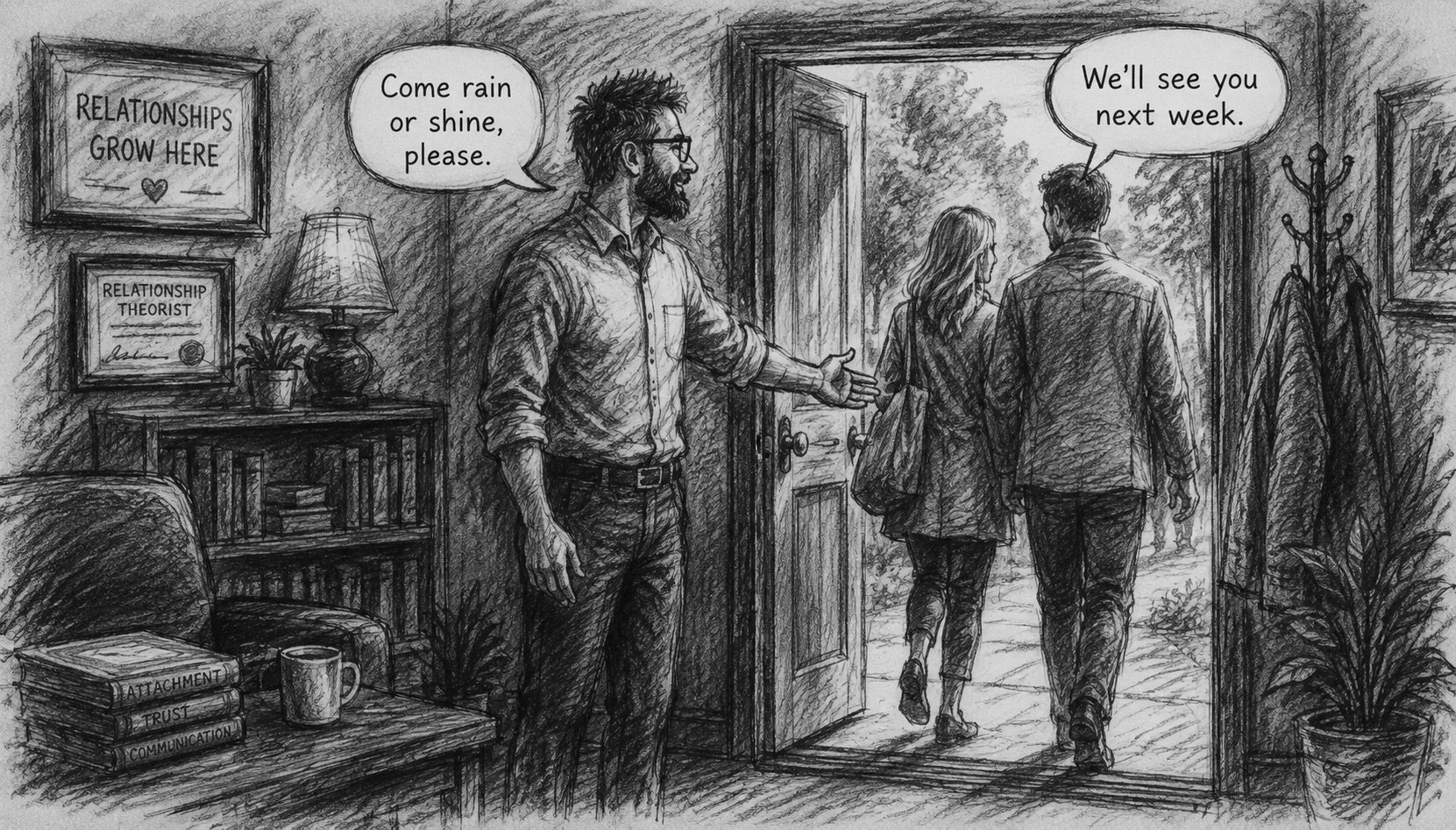
No guarantee I’ll see them again. See the value. Prioritise relationship health.
When your therapist asks to lock in more sessions, it’s more than just their sales technique. Roll your eyes at the ‘upsell’ but this is actually closer to the professional’s duty of care. There’s an element of wanting to see a prescription through to the end. The work isn’t complete. The work is more successful when it’s done on a weekly basis, a cadence that allows the subject to not forget the objective and the therapist to not forget the subject’s story — since they might have dozens of clients in a month.
Both parties in a couple, and in fact all parties in a throuple, can be a complainant but normally there is one major plaintiff. The applicant is not always the plaintiff — sometimes the partner that’s ‘getting it in the neck’ is the one who books me initially, and the first session is often with one of the couple/ throuple before they see the benefit of bringing their partner(s) along next time. And so a sustainable account means leaning on the side of the commissioning party more than the other whoever that be.
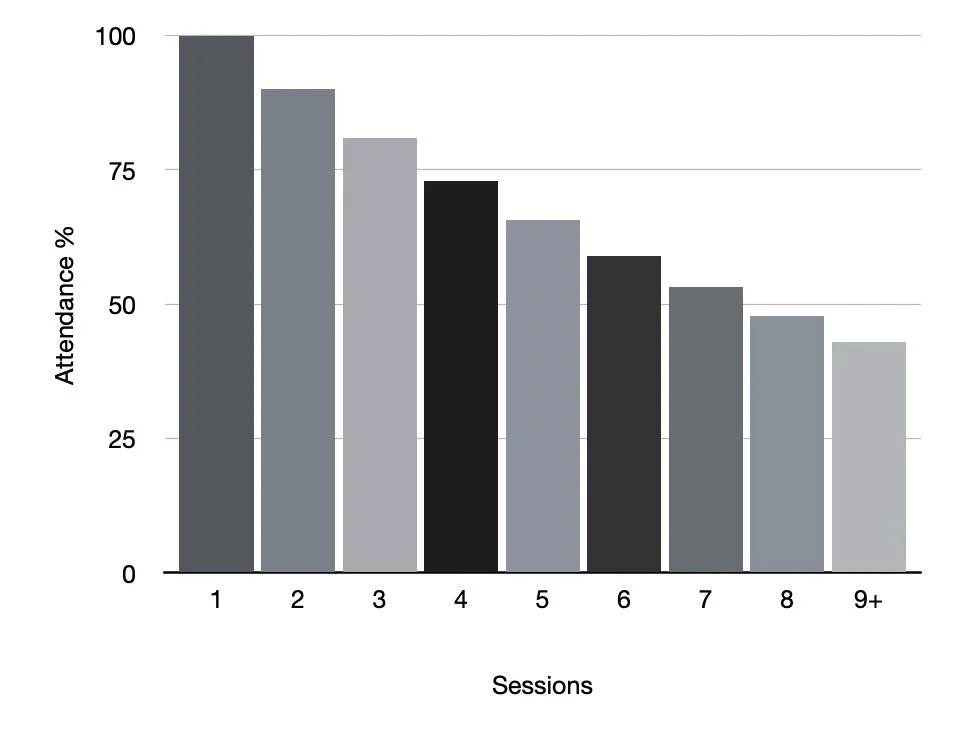
Since the drop off between sessions 4 and 5 is about 10%, and the drop off between sessions 1 and 2 is 40%, I remove a bit of the stick to the carrot around booking that second session by zeroing the fee. I was therapy to be affordable and low stakes for all without underselling myself by discounting therapy so much as removing an early-exit point that is statistically predictable to provide quantity of discovery and counselling type sessions before shifting to quality precision work. The first session is high-friction: disclosure is new, the alliance is untested, and each party is still privately evaluating whether I am ‘for them’.
In practical terms, session one is largely diagnostic and contractual. I’m mapping attachment strategies, conflict styles, erotic scripts, and the implicit rules of the relationship system. I’m also setting frame or ‘contracting’ as my tutor calls it: confidentiality boundaries, how we handle asymmetrical disclosure, what constitutes progress, and what I will interrupt. None of that is therapeutic change in itself. It is the scaffolding that allows change to occur. Session two is where I start to introduce constraints and experiments — small, observable shifts that generate data, from hypotheses to iteration.
Couples and throuples introduce an additional complexity: plural subjectivity. Each person arrives with a coherent internal narrative in which their behaviour is justified and the other’s dragging is excessive or being dragged is uninvested. My job is render the system visible — who pursues, who withdraws, who regulates emotional temperature, who destabilises it. That requires repetition and triangulation through 2+ topics. Patterns only reveal themselves across instances. A single reading is easily explained as an anomaly.
There is also a retention bias that clinicians tend to ignore at their peril. The partner who feels most exposed in session one is the least likely to consent to a second session. If that person opts out, the therapy collapses back into an individual consultation with the remaining partner, often reinforcing the very asymmetry we’re trying to unwind. Removing a financial barrier by keeping the same flat rate for singles, couples, and throuples (no quads please!) is effective way of keeping the more reluctant party in the room long enough for them to experience that the process is not a tribunal.
From a duty-of-care perspective, there’s an ethical argument here. If I have reason to believe that discontinuation after session one leaves the couple or throuple in a more volatile state, because disclosures have been made, grievances surfaced, but no containment or repair process established, then encouraging a second session isn’t commercial opportunism. It’s damage containment. We’ve opened something; we should stabilise it. It’s not unheard of.
None of this eliminates the commercial viability… okay… I’m running basically at a loss, but I’m not qualified yet as a big authority or psychotherapist so wouldn’t want to charge more than I do. But eventually a practice has to be sustainable.
Finally, cadence matters beyond retention. Weekly work creates a temporal container in which commitments can be made, rehearsed, and reviewed before they decay. When a couple or throuple agrees to a behavioural experiment 7 days is short enough to maintain fidelity and long enough to generate meaningful data. Make that inconsistent or stretch the inteval to a month and the practitioner loses signal, loses resolution. The story mutates, the specifics blur, therapy becomes check-ins or commentary rather than focus and intervention.
Repeat clients tend to be those who can tolerate sustained self-observation and who recognise that change is a time investment. They present with enough psychological, logistical, and financial stability to maintain a weekly cadence, but also enough curiosity, rapport, or life dissatisfaction to keep the work alive. In couples and throuples, it’s the configurations where at least one party is motivated by curiosity or optimism and where the more reluctant partner is willing to remain engaged long enough to see that the process is not adversarial.
