
CAPTION
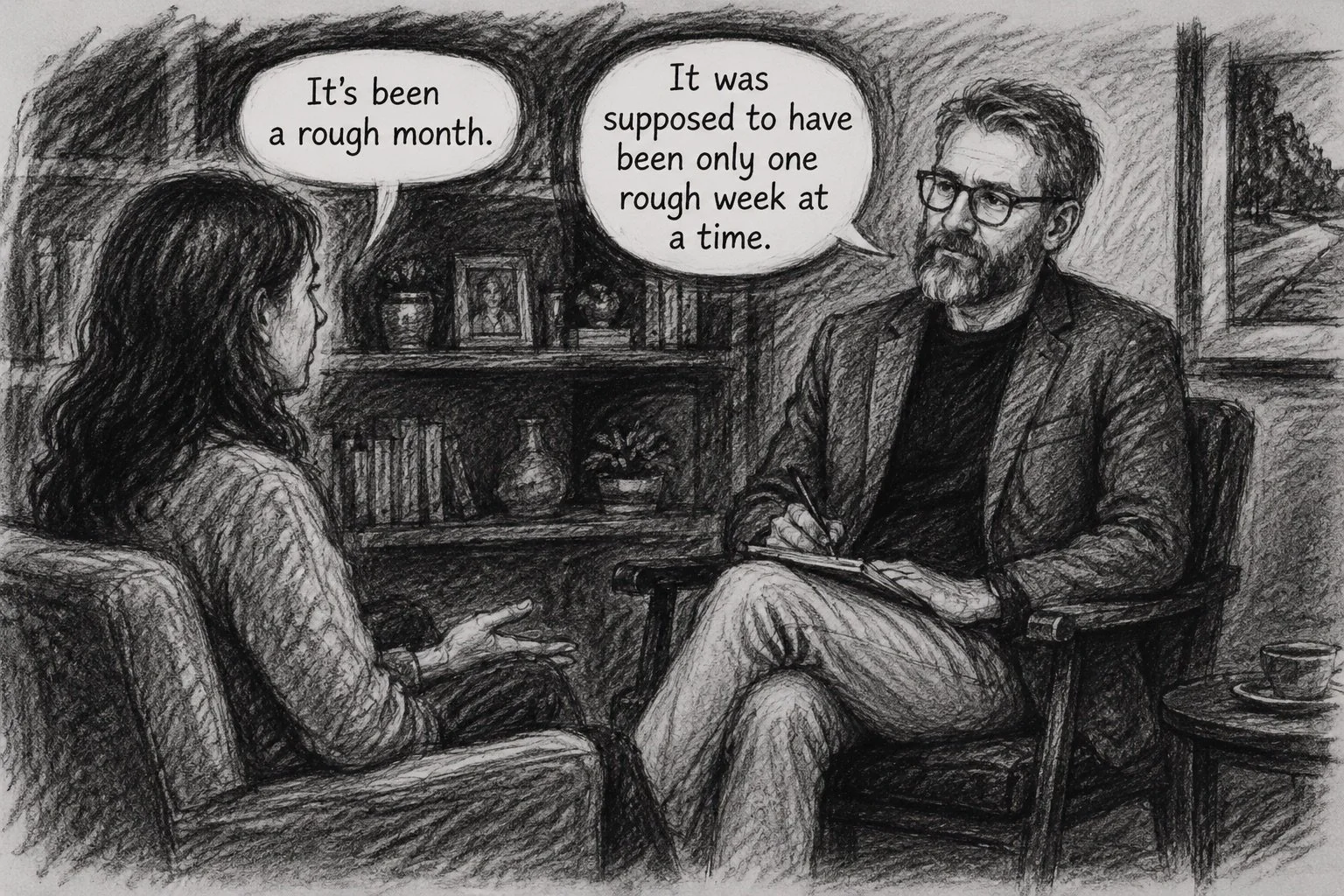
“It was supposed to have been only one rough week at a time.”
Therapy isn’t like taking one’s car to the garage. Solo mental health and relationship health can be a checkup or pitstop, but most of the time, people are reaching out because they are lost. A therapist can show the enquiring individuals the map but can’t get them to their destination. A therapist can show them where they are, where they want to be, and how to get back on track. But the trudging through the thickets and marshes to get back on track is a matter of looking at that map every week in session, then reorienting towards the safer route, the one with the vistas and cairns built by those who crested along the way. That’s why consistency of attendance plays such a critical role in making therapy actually work.
A 2019 systematic review in Psychotherapy Research that synthesised 26 studies found consistent support that the optimal dose of psychotherapy in routine free clinical settings generally falls between 4 and 26 sessions, with outcomes improving in a curvilinear pattern as sessions accumulate. A large naturalistic study led by researcher Kevin Erekson, using outcome data from more than 21,000 university counselling centre clients tracked over 17 years, compared people attending therapy weekly versus every 2 weeks. The study found that higher frequency was linked to speed and overall likelihood of clinically significant improvement.
Change Happens Through Repetition, Not Revelation
People carry patterns in how they think, relate to others, or respond to stress. These have been reinforced over years, sometimes decades. A single conversation can offer insight, but won’t change behaviour. What actually shifts patterns is practice, being held to a standard that rewards repetition until the updated protocol starts to feel less new and more natural.
Weekly sessions create a rhythm for this kind of reinforcement and refreshment. Each meeting builds on the last. A skill introduced one week gets revisited and refined the next. Without that regular touchpoint, progress tends to reset; people forget what they were working on, slip back into old habits, or lose momentum before a new way of thinking has had the chance to take hold. Weekly sessions act like scaffolding. They support intention in place while new patterns are still forming.
Deeper Conversations
A lot of the value in therapy comes from the relationship between client and therapist. Trust builds over time through the regularity of repeated rapport. Iterative interactions lead to the openness needed for traumatic revelation, nurtured through safety. A therapist who sees someone weekly gets a much clearer picture of that person’s life: their stressors, their relationships, their emotional patterns as they unfold in real time.
My sessions are supposed to spend 15 minutes talking about the week, 15 minutes talking about reflections on the program and 15 minutes doing an exercise or exploring new modalities of being. Come to me with 35 minutes of surface-level recap of things that have happened in the last month, and you can expect to tread water.
Memory and familiarity
Counsellors stand a better chance of just remembering the details between sessions if they are regular and plural. It’s a lovely feeling when your friend remembers small details and helps you fill in the backstory to your own fresh anecdote.
Face-to-face continuity allows a therapist to find significance in new tells — a change in tone, a recurring worry, a pattern that only becomes visible across several sessions: “You look more concerned/ contented than usual. Something’s different this week.”
Memory goes both ways; life doesn’t pause between sessions, as realisations don’t. Each mental cog turning is of clinical significance and timely import to the program, and is best brought back into discussion in good freshness. Knowing there’s a session coming up where progress (or lack of it) may be discussed creates a gentle but meaningful form of accountability and capacity recognition. “I can’t ponder on this more until Tuesday morning, when Ryan will give me his take on it.”
Life isn’t scheduled, but the tools for it can be
Stressors, conflicts, and emotional challenges don’t wait for a convenient time to show up. A weekly cadence means there’s rarely a long gap between something happening and having a space to process it. This proximity in time makes it easier to work through issues while they’re still fresh, rather than trying to reconstruct them from memory weeks later, often after some other coping strategy, healthy or not, has already been used to manage the feelings in the meantime.
When Less Frequent Sessions Make Sense
In the early stages of therapy, weekly sessions are important for discovery. During periods of active struggle, weekly sessions tend to offer the learning and structure needed to make meaningful progress possible. None of this means weekly therapy is required forever, or that it’s the right fit for everyone. As people gain more insight, build stronger coping skills, and feel more stable, many accounts transition to biweekly or monthly check-ins, using sessions more for maintenance than active change. The frequency of therapy should shift with a person’s needs, and a good therapist will typically discuss this openly rather than assuming one pace fits every stage.
My gift to you
My sessions are available late into the evenings.
My sessions are postponable without penalty.
My sessions are available in person or online.
My sessions are accompanied by detailed notes to take away.
My 2nd sessions are free.
I don’t make clients sign contracts about cancellation or minimum notice.
I don’t make clients bulk buy 6 sessions at a time.
TIME WITH ME IS HALF THE PRICE of the going London rate.
All of these are designed to make it as easy as possible to visit weekly, and talk to me about your successes and challenges in the last and coming week. Bring your excuses out of ‘I don’t have time’ to ‘for some reason I’m not prioritising this’. Help me to help you.
