
On Cheating, Terms, and Considerate Behaviour
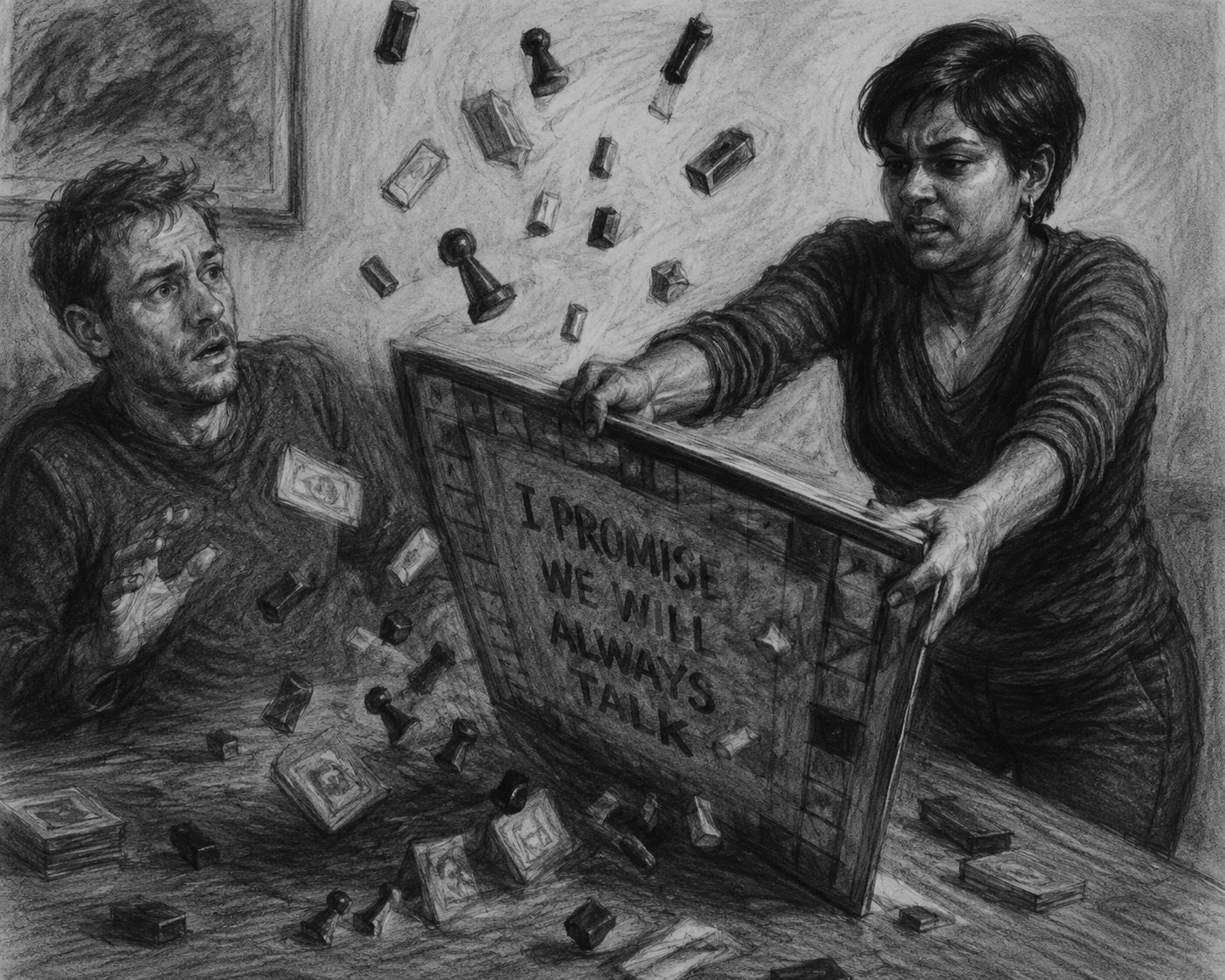
She was playing a completely different game.
Eolanda and I attended a talk by Rosie Wilby where she shared results from a survey she did about what constitutes cheating, asking the audience what they thought about various situations. We bonded over the fact that we had not just the same answers as each other, but also the same answers as Wilby and her data. We knew about cheating. It wasn’t complicated. E and I were bulletproof. A year later, I was hiding sexual encounters from her.
Organising or capitalising on opportunistic casual sexual interactions was not a dealbreaker in our relationship, but Eolanda said that she wanted to know every time I hooked up with someone. The next question should have been ‘why?’. Using the analogy I introduced in my article On Open Relationships, there’s no clear line between why I wouldn’t have to mention that I had ‘tennis, tapas & coffee’ with a uni buddy versus a quickie with a Feeld buddy. If we skew allistic and think in terms of grey zones, then we are designed to live in grey areas. But once again everything in a partnership is negotiable and a lot is assumable.
My mistake was first assuming that E didn’t want to hear about my encounters since she was very negative about them. Then I realised that I didn’t tell E about them because she was very negative about them. Friends started to see this and would then ask us if open relationships were right for her. She was the reason why several thirds and couples we played with didn’t want to play again. They said they felt E’s heart wasn’t in it. Her response was always “I promise I’m into it,”’ although her patterns never changed. Mine had to in order to give her time to catch up, to practice what she promised. But she failed. With every playdate E went on, I loved her more. With every playdate I went on, E resented me more.
Romantic vs Sexual Cheating
Since the happy conclusion of dating (spending time with the objective of exploring romance and value alignment) is partnering up, conversations about exclusivity must be had. American Psychologist Scott Stanley’s Before I Do Report published by The National Marriage Project noted the significance of this rulesetting, since ‘deciding, not sliding’ gives clearer ideas about what would cause upset and how to handle transgressions. Stanley’s work including 4 editions of Fighting For Your Marriage (2002) is unfortunately a little Christianity and matrimony-centric, but his work has looked at the predictive power in marriage longevity of variables like children from a prior partner, number of previous partners, number of previous nesting partners, sexual partners, sex before marriage, context of first meet, and what the wedding was like.
Romantic exclusivity typically comes first in the format, “I’ve stopped dating other people. Have you, babe?” If the answer is ‘yes’ then the expectations for a romantically closed partnership have been set. Dating others now is emotional cheating. Romance now is akin to a thought-crime. Here’s where some understanding comes in handy.
You have a friend from Feeld. You’ve recently met but the interaction is off the chart. Even if you didn’t know exactly how to touch each other, the evenings you spend together would be a very sacred corner of your fortnight that you feel yourself looking forward to, even ringfencing. Things could have been so different. But your partner’s imprint on your heart is automatically or consciously preventing you from saying “are we giving this a go? Am I your plus one? Are you my emergency contact? Are you meeting my parents? Are you on my life insurance? Are we going to move in together and get a joint bank account, and discuss parenting, and live each day as if we are going to grow old side by side?” For if you did, you’d be cheating.
Next is a chat about sexual exclusivity in the format, “I’ve stopped having sex with other people. Have you, babe?” If the answer is ‘yes’ then the expectations for a sexually closed partnership have been set. Having sex with others now is sexual cheating. Sex now is akin to a physical crime. Here’s where some understanding comes in handy.
You have a buddy that you go to adult parties with. Your partner doesn’t attend. They can’t stand the music. A whole third of the club is taken up by easy-wipe benches and saltires, and swings, and curtains that do little to preserve privacy and stop eyes from meeting from across the room. Historically, if either of you couldn’t pull, then you would happily fall back on each other at 2am as a sexual consolation prize. You respect each other. You make each other cum, but you just aren’t each other’s types. It could be so easy to just please each other now that it’s half past 2 and your buddy still hasn’t got laid and is groping you drunkenly. But your partner’s imprint on your brain and groin is automatically or consciously preventing you from saying “bend over”. For if you did, you’d be cheating.
Understanding the Language
When we take a look at our last or current partnership, we might draw a distinction between 3 admissions and 1 conversation:
What we know could happen — “It’s possible that you or I will fall in love with someone else. Let’s not deny that but stay aware of it. Don’t be ashamed if you develop feelings for Debbie from accounting. Let’s navigate that, especially if we agree that love is not finite.”
What we think will happen — “We will be in love for as long as we have a good experience of each other. The love will mature, we will have roadbumps but we are a good team and our ability to heal will keep us close. Although I think within 15 years… if friends had to put money on it… we will not be together; Statistically, the odds are against us.”
What we want to happen — “A life partner is a fine thing. I want to become closer, stabler, securer. As long as we are happy in this, I don’t want you to change values or behaviour from what we’ve come to know and expect of each other.”
Here’s what we can do to give ourselves the best odds — “We set objectives for the partnership. And we take active or passively chance-maximising steps to bring that to fruition. If it doesn’t happen in a sensible timeframe then we will have another conversation. But we also need guardrails so let’s talk partnership terms.”
Here’s the tricky part. For every guardrail we would ideally discuss the following:
“If you were to (not) do X it would make me upset. In fact I’d feel Y
“I think this comes from Z in my past OR
“I think this is N% normal to react negatively that way.
“I do (not) intend to work on the remaining 100-N%.
“If you (don’t) do X and (don’t) tell me, it will be harder for us.
“Do you see a problem or want to argue some edge cases?
In practice this looks like:
“If you were to not get to know my dog it would make me upset. In fact I’d feel unimportant to you. Like I’m not worth trying with. I think this comes from my last relationship when my ex didn’t make an effort and then got in a new relationship and was posting pictures of his new partner’s dog all the time. I think this is 60% normal to reach negatively in this way. There are probably loads of reasons why he liked his next girl’s dog better than mine. I intend to work on the remaining 40% because I realise it’s a small factor and my dog is a bit ugly.”
Aversion to moving in together, marriage, joint bank accounts, and kids might be seen as a one-foot out of the door strategy, but it is healthily used as an option to solidify ourselves in the relationship by making it as easy as possible for our partner to leave us. When it is primarily love that is keeping the relationship together, the reality of choosing each other every day becomes the most useful method to form a secure attachment.
Orion Taraban pushes back against the idea of a 2nd-person boundary (Control) as a lazy imposition [See — On Boundaries]: “Saying that we only love those who respect our boundaries is akin to saying that we only love those who give us what we want.” Boundaries aren’t enforced as set-and-forget red lines, but more as no-man’s land, where both partners fear to tread but do change with attrition and erosion.
Research
The eternal debate continues: which sex is most likely to have dalliances, and which sex is most likely to stray for a day? The old adage tells us that men most likely cheat for ego and women cheat for emo (emotional connection), meaning that if partnered men were to grow close to a third for emotional connection, then this contravention takes a more serious category. It also means that if partnered women were to sleep with a third for their sexual facilities then their partner would feel libidinously challenged. However I feel that this more carnal type of adultery would not land quite as intemperately were the woman’s partner female — leading us to wonder if it’s just quintessentially straight men whose sexual acumen is so precariously fragile.
Studies on infidelity consistently find that men report cheating slightly more often than women, although the gap has narrowed over recent decades. Large heterosexual samples in North America and Europe typically show rates of sexual infidelity around 20–25% for men and 10–20% for women. One widely cited study from the Kinsey Institute found that 23.2% of men and 19.2% of women in monogamous heterosexual relationships reported cheating during their current relationship. Men’s infidelity correlated more strongly with sexual novelty-seeking and excitation, whereas women’s infidelity correlated more strongly with relationship unhappiness and emotional dissatisfaction.
Cross-cultural studies show substantial variation between countries. Infidelity rates tend to be reported as higher in more sexually permissive Western societies and lower in collectivist or religious societies, some of which support polygyny, although underreporting is a major issue in conservative cultures. Comparative studies involving countries such as the United States, Germany, Britain, China, and Finland have shown that attitudes toward jealousy, same-sex infidelity, and sexual exclusivity differ strongly according to social norms and gender expectations. For example, British and Chinese participants in one cross-cultural study both showed higher male tolerance toward female same-sex infidelity than women showed toward male same-sex infidelity. That scale again which starts with looking at lingerie catalogue models, through watching porn, through phone sex, to full congress.
Lesbian couples generally report the lowest rates of infidelity and the highest preference for monogamy. A German study found lifetime sexual infidelity rates of 49% for heterosexual men, 29% for heterosexual women, 34% for homosexual men, and 4% for homosexual women, though methodology and definitions varied considerably. And so the sliding scale of severity rears its head, make even more slippery by the varied definitions of ‘cheating’. One person’s irretrievable betrayal is another person’s annoying, eye-roll-worthy lack of self restraint.
Considerate Behaviour
For a romantically-closed couple or throuple, it’s important to have patience and understanding that curious lusts and amorous sweetspots require no touching or even much time to develop. Practically, connections could mean continuing to orchestrate intimate moments with another, failing to appreciate the feelings that are growing or re-prioritising time, attention, and resources towards another in a way that interrupts a relationship with our primary.
Should we be betrayed, we don’t want to act like thought police. We’d best outline how we’d like to be treated in the scenario where we are falling for someone else, with contemplation and gender symmetry, for it may well be we who are the ones to fall in love with another, maybe that cute barista who is always telling us about their failed dates every time we automatically wander in for that more expensive oat-filter, even though Pret is just round the corner.
So cheating is defined by explicit transgressions but also passive secrecy, active deception, lying about emotional intention, even failing to disclose romantic feelings for others if that’s important although I can’t see how except to use our partner as a sponsor to help us track and surpass any embryonic infatuation. heating in non-monogamy centres on dishonesty. All relationships though are prone to a lapse in what I call ‘considerate behaviour’.
It doesn’t have to be terms of the partnership being contravened that unsettle a relationship. Undiscussed human decency’s evil mirror image is ‘inconsiderate behaviour’. Consistent considerate behaviour is the cornerstone of longevity. Lives entwined necessarily touch on the philosophy of serving, sometimes each other (although not necessarily), but always the relationship. Such attunement is reactive to our partner’s contextual and mental state. It is multiplicative when in adherence with their values (you might put their name down for a limited time offer coffee tasting afternoon next Saturday. This is great for a coffee lover with a free calendar, but a disaster for a non-coffee drinker who has a busy weekend.
Too many acts of inconsiderate behaviour, and the relationship will erode. I use the analogy of “terms of proper use”. When claiming a warranty on a kitchen appliance, it’s more likely to be voided by evidence of improper use. Who knew you weren’t supposed to put steak in the toaster? A relationship too is less likely to be refreshed with every act that shows lack of understanding or disregard for the other.
At the centre of my story was a promise to always find time to talk about why Maya and I might be upset with each other, if and when it happened. When it happened, she reneged on that promise, a promise that was supposed to be the first safety net of many, and I fell.
From this experience, I’ve learned to hold staying spiritually consistent, communicatively available, and graciously honest to be trifecta of faithfulness. This way, cheating becomes far more about the splash-damage of ambivalence and not the wrong-turns of infidelitous curiosity [See — On Situation, Intact, Action, Impact]. As Gary Johnston says to Lisa in Team America (2005), “I didn’t mean to hurt you.”
“Yes but you just didn’t care if you did.”
