
On Inappropriate Anger
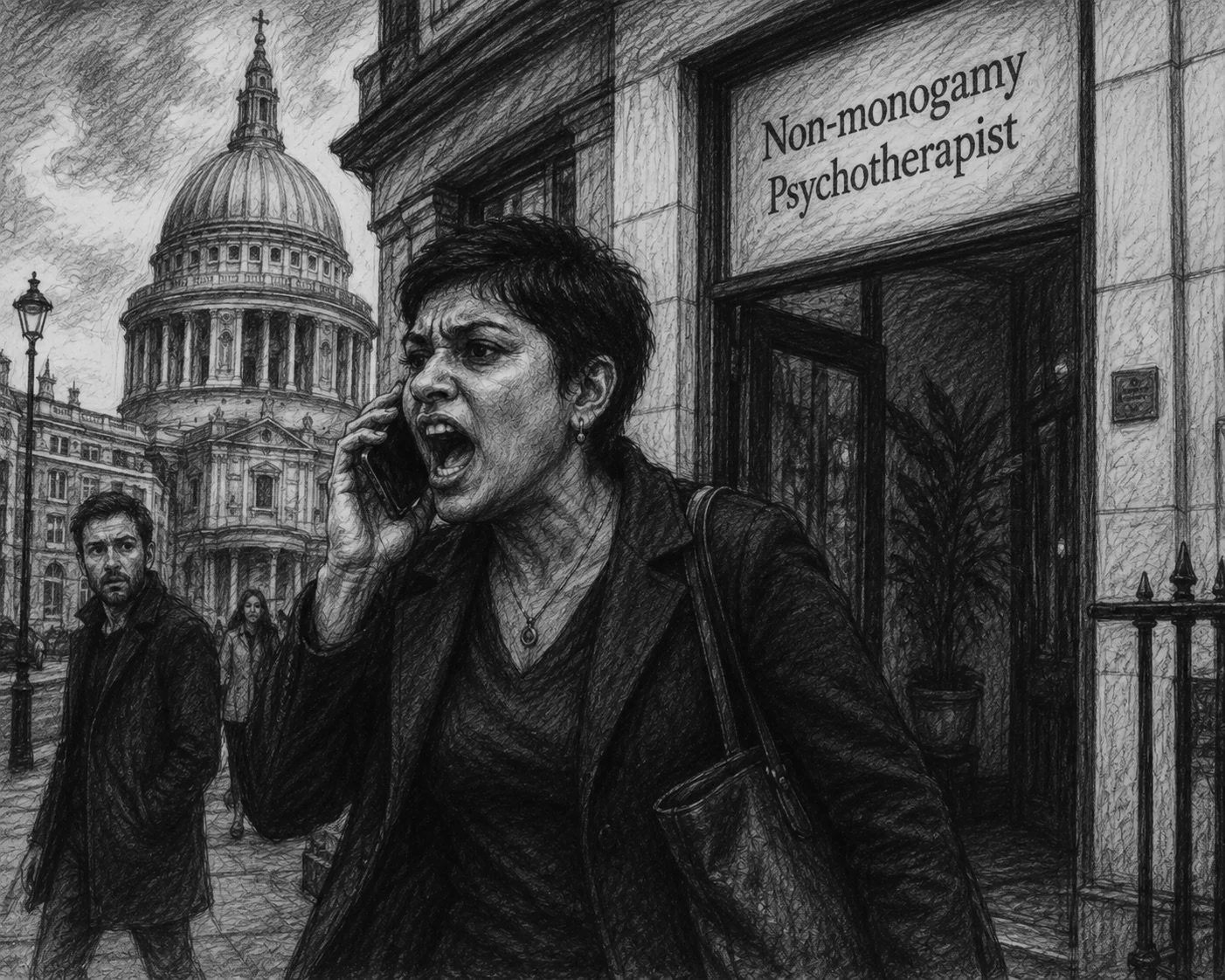
She’d literally just come out of a therapy session.
“I’ve never felt an anger like this. I’ve had this fire in my stomach for 2 days.” If I took Maya’s post as face value, then she had every sympathy. Not only is there nothing I can imagine anyone doing to me that I would be that angry about, but to think that what she accused me of doing had nothing to do with her by her own admission, and so the resultant rage is even further from my understanding.
Maya was also very angry at me during The Concert Incident when I spoke to a girl whilst high and giddy. Maya was irate at Titlee for being at Anant’s all the time which made Anant refuse to let Maya come round to see The Cat. She was also very annoyed at Todd after their radio-silent week together, where the things that were said and done can only be speculated at.
In these situations, why wouldn’t she have been distraught and upset and depressed rather than angry? Why did it take her days or weeks to voice her concerns? What I discovered warranted its own chapter.
Anger is known as a secondary emotion because it often rides on the back of more vulnerable states such as jealousy, grief, shame, sadness, humiliation or embarrassment. While emotions like disappointment and hurt direct attention inward toward loss, anger redirects attention outward toward blame. It is an attempt by the nervous system to restore control, reverse vulnerability and shift scrutiny away from the self and onto another person. In this sense, fury is not merely emotional activation but a defensive reorganisation of consciousness itself. The individual stops asking “What happened to me?” and starts demanding “Who is responsible for this?”
Relative Deprivation Theory, developed by American sociologist Samuel Stouffer and later expanded by political scientist Ted Robert Gurr, shows that anger is driven less by absolute harm and more by comparative unfairness. Human beings are often less disturbed by suffering itself than by the perception that they or other have been treated worse than they deserved relative to others or expectations. The emotional equation becomes simple: “I came off worse than I should have, therefore somebody must pay.” This framework has been used to explain everything from interpersonal resentment and domestic abuse to riots, political extremism and collective violence.
Some of these possibly noble causes — one might call them 2nd hand moral outrage — require empathetic anger: being angry on behalf of someone else who is calmer. In a certain light this looks noble but it’s often misapplied. And let’s keep in our mind as well the phenomenon of meta-anger, which is the rising to ire based solely on the fact that an ally is angry, or counter-anger which is the rising to ire based solely on the fact that an enemy is angry.
The brain’s preference for anger over sadness is partly neurological. Sadness, grief and shame are metabolically expensive states associated with helplessness, passivity and social exposure. Anger, by contrast, is energising. It increases physiological arousal, narrows cognition, boosts certainty and creates the subjective sensation of strength. Neuropsychologically, anger is an approach emotion rather than a withdrawal emotion. A person in despair collapses inward; a person in rage advances. For individuals who experienced environments where vulnerability was ignored, punished or exploited, anger may become the only emotional state that feels psychologically survivable.
American neuroscientist Stephen Porges noted in The Polyvagal Theory (2011) that following a threat response there may first be a period of shutdown or emotional numbness before anger emerges days later, once the nervous system feels sufficiently safe enough to mobilise against the original threat. This delayed anger response is often observed after domestic abuse, medical trauma, combat exposure and relational betrayal. The nervous system initially prioritises survival and emotional containment. Only later, when collapse recedes, does outrage surface. This helps explain why some individuals appear to become irrationally angry over minor incidents. The present event is often not the true source of the reaction but merely the final symbolic trigger attached to older feelings of humiliation, abandonment, disrespect or powerlessness. The nervous system does not distinguish cleanly between current threat and historical threat. A partner arriving late, a dismissive tone of voice or an unanswered message may unconsciously reactivate much older emotional injuries.
Inappropriate anger in response to perceived slights is a hallmark of cluster B personality pathologies. American psychologist Todd Grande identifies disproportionate anger and aggression as one of the clearest indicators of Borderline Personality Disorder after splitting [See — On Splitting]. “One of the most important symptoms that contribute to a relationship’s trail of destruction is not only anger, but aggression. I found that, if people in a relationship with an individual with BPD can endure the affective instability, unstable relationship pattern, frantic efforts to avoid abandonment, and all other symptoms, they still can’t endure their anger, in particular their aggression. We even see cases where BPD anger terminates patient-therapist relationships.”
Attachment Coach Paulien Timmer similarly observes that disorganised attachers often appear powerful because they become explosive, confrontational or emotionally dominating during conflict, yet internally experience themselves as profoundly lacking control. “Disorgs seem powerful because they get angry and lash out, but I’m yet to meet one who admits to feeling truly powerful. They feel like they don’t have influence on their emotions.” For them, rage creates the illusion of agency, but it actually hijacks the brain without sufficient interruption. We’ve all heard the phrase “They’re out of control”, which is almost as scary as “not guilty by reason of temporary insanity.”
Contrary to popular belief, successful insanity defences are exceptionally rare and have become more difficult to secure since the public backlash following the John Hinckley Jr. case in 1982. Studies by forensic psychiatrist Henry Steadman found that insanity pleas are raised in well under 1% of felony cases and succeed only in a fraction of those. Modern courts are generally sceptical of rage-based explanations unless they involve severe psychosis, dissociation or profound cognitive impairment. The stereotypical “crime of passion” defence has steadily lost legal legitimacy over the last several decades, especially as neuroscience increasingly distinguishes ordinary emotional dysregulation from genuine incapacity to understand right from wrong. Today, successful insanity verdicts are reserved for schizophrenia-spectrum disorders, manic psychosis, severe delusional states, neurological injury or trauma-linked dissociation [See — On Dissociation]. Research finds that successful insanity acquittees are disproportionately male, socially-isolated, psychiatrically hospitalised and frequently psychotic at the time of the offence.
Chronically angry individuals often unconsciously reshape narratives to justify the intensity of their emotional reactions. Once the nervous system has entered a state of rage, cognition becomes subordinated to emotional congruence. Ambiguous interactions are reinterpreted as deliberate disrespect. Neutral events become evidence of persecution. Motives are assigned retroactively to support the emotional conclusion already reached. In this way, anger does not simply emerge from a story; the story itself is rewritten to accommodate the anger.
This is partly why angry people can appear sincerely convinced by interpretations that seem objectively distorted to outside observers. The anger comes first; the justification arrives afterwards.
