
On Modelling and Anti-Modelling
CAPTION
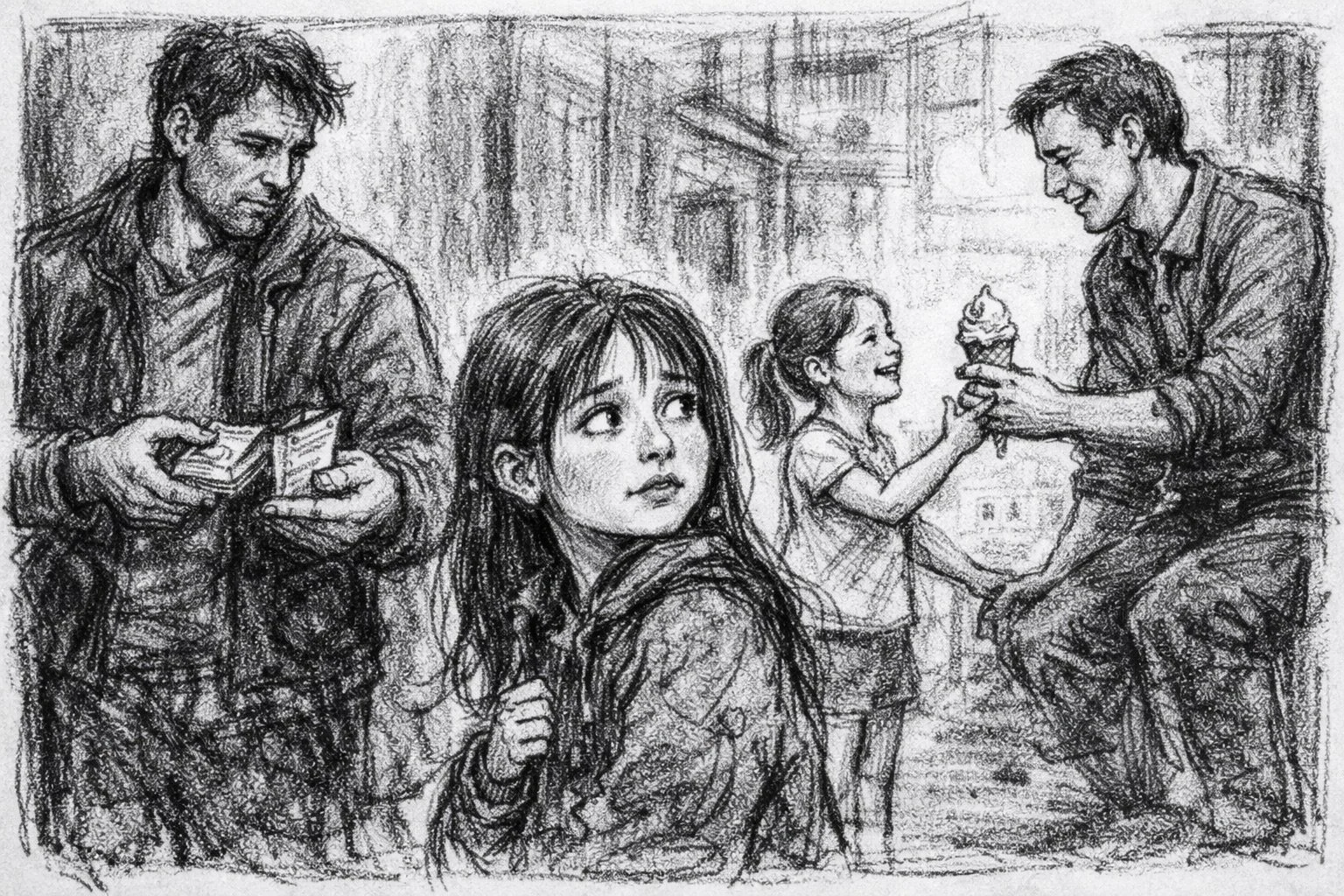
“My dad is completely different to that dad. That little girl is completely different to me. Am I following one and steering clear of the other?”
If there’s an element of my upbringing that I am determined not to propagate on to my own children, it is the sense of distance and detachment that shaped so much of my early life. Being sent to boarding school fostered a feeling of isolation from my family, as though I was a visitor in my own home during the rare times I returned. The fractured nature of a broken home only deepened that sense of instability, leaving me and brother George to navigate formative years whilst being passed like a hot potato of inconvenience between parents. And the times we were home, they weren’t, as they were consumed by work. I grew up observing the world at a distance, always hoping for parental interaction in the things that lit a fire in me. The daily help too was not affectionate nor interested in my passions. I gained an unhealthy addiction to video games, which in my completion compulsion became a trophy cabinet to honour a misspent youth.
I was worried that I would pass on the same environment to my kin, since we learn that troubled kids make for troubling parents. Could I eventually build a home where my children feel deeply rooted, seen, and supported, where they know that their interests matter, that love is not something scheduled between tasks or tethered to external achievements? It’s not to fix the dark things about my youth, but I just wanted to stay aware of any intergenerational patterning. In the words of the 2016 novel and 2024 film, ‘it ends with us’.
I was worried that I would pass on the same environment to my kin, since we learn that troubled kids make for troubling parents. Could I eventually build a home where my children feel deeply rooted, seen, and supported, where they know that their interests matter, that love is not something scheduled between tasks or tethered to external achievements? It’s not to fix the dark things about my youth, but I just wanted to stay aware of any intergenerational patterning. In the words of the 2016 novel and 2024 film, ‘it ends with us’.
If you’ve ever read or seen Mindhunter, you’ll know that one of the FBI’s forensic psychologists’ biggest breakthroughs in understanding what makes a serial killer is that they became edge cases due to a troubled youth. And so they were destined to perpetuate pain. Whereas psychopathy is an affliction that prevents the ability to empathise with others, it has overlap with the idea that if you’re taught to use violence as a tool then you will exercise it rather than exorcise it in later life. But we hear of so many people who are determined not to perpetuate the cycle of mistreatment according to a role model that they perhaps didn’t meet until their developmental critical windows had long since shut.
Modelling theory starts from the observation that human behaviour is largely learned through imitation rather than instruction. From early childhood, we absorb not only what our role models say, but how they regulate emotion, handle conflict, express care, and use power. These patterns are copied implicitly and later experienced as traits, even when they reproduce harm or dissatisfaction. Without alternative examples, people tend to recreate familiar dynamics, mistaking familiarity for inevitability.
In relationships, modelling explains why people by default repeat patterns they explicitly dislike. A person raised around withdrawal may withdraw under stress; someone exposed to volatility may associate intensity with intimacy. This is because they were never shown a viable alternative in their developmental critical window. Realisation alone rarely breaks the cycle; behaviour changes when a different way of being is observed and felt as possible.
And so, Anti-modelling describes the energy-intensive, compensatory response: the attempt to become the opposite of a problematic role model. Anti-modelling is more often exhibited when the learner of people they care about is the victim of the problematic model. While it can prevent the repetition of certain harms, it often produces rigidity rather than freedom. For example, someone who grew up with emotional absence may overfunction emotionally, or someone raised around control may reject all structure. Anti-models are still governed by the original pattern, just in reverse and are just as common.
The limitation of modelling and anti-modelling is that they remain reactive. One copies, the other inverts, but neither is chosen freely. Change becomes possible when a 3rd option is introduced we might call hybrid-modelling: healthier, regulated, neither the original nor its negation. This can come from demonstration in relationships (not of the acts, but the theory behind them), therapy, or deliberate practice.
In Hybrid-Modelling, the aim is not to replace one template with another wholesale, but to help us consciously select what to keep, what to discard, and what to learn anew. This way, we can stop treating inherited patterns as destiny and start treating them as material. The presence of a consistent, boundaried, and emotionally regulated significant other does more to enable this shift than explanation alone.
Modelling is captured in Beyond the Pleasure Principle which included Freud’s 1920 findings on Repetition Compulsion, the unconscious drive to reenact traumatic events or painful relationship dynamics. He posited that the impressionable copy in an attempt to finally “master” the original unresolved wound. Without conscious awareness, this cycle often leads generations of self-sabotagers. Instead of consciously remembering or processing past pain, the mind acts it out in the present as a contemporary experience. The mind creates these familiar yet painful scenarios in an unconscious effort to rewrite the history and achieve a different, more resolved outcome.
Freud realised that many patients endlessly repeated distressing scenarios, contradicting the idea that humans are solely motivated by pleasure or that, Hedonistically speaking, they derive more pleasure from carrying out their compulsions than striving to achieve escape velocity.
Continually choosing romantic partners who exhibit the same toxic traits as an emotionally unavailable or abusive parent or ex is a classic example. And the counter is continuing to be the abusive partner in a relationship, expecting something in the nature of the suffering abusee to change. Instances were observed where a child would play a game where they throw a toy away, only to pull it back repeatedly, which was speculated to be a way of practising exposure to and mastery of the anxiety induced by an absent parent, which sits at the heart of disorganised attachment. Ex-disorg and attachment coach Katya Morozova says “disorgs haven’t been given a good model of what a healthy relationship looks like. What they are seeking is unrealistic, ungrounded, one-sided, taking not giving, lopsided.”
Repetition compulsion thrives in the unconscious. Breaking free from the loop relies on awareness, exploring the root cause, and deliberately choosing a better way of being, almost overriding programming to uproot deeply ingrained habits.
