

Low responsiveness with high demandingness versus high responsiveness with low demandingness
watched Bea and her mother in dismay. Immediately over the smallest thing there was tension, escalation, impatience, defence, anger.
It could be as simple as “Bea, where are you?” “WHAT DO YOU WANT NOW?” or “Bea, what do you want to do this weekend?” “WE’LL DEAL WITH THAT LATER!” I saw a stark contrast in that compared to the dynamic between my Mother and my ailing grandma as she looked after her. There’s no space in that shift in power-impotence, shield-armour dynamics that allows for shouting one’s frustrations, without it looking like verbally assaulting an infirmed OAP, or nearly literally granny-bashing.
I decided to read into what keeps young and old together.
American Psychologist Diana Baumrind’s research in the 60s and 70s identified 2 primary factors of parental methodologies describing how they approach information going out to their children and coming in from them: demandingness (control, structure) and unresponsiveness (coldness, unacceptance). One’s position on these 2 spectra can inform how one is categorised under this model. Time for another 2 dimensional grid!
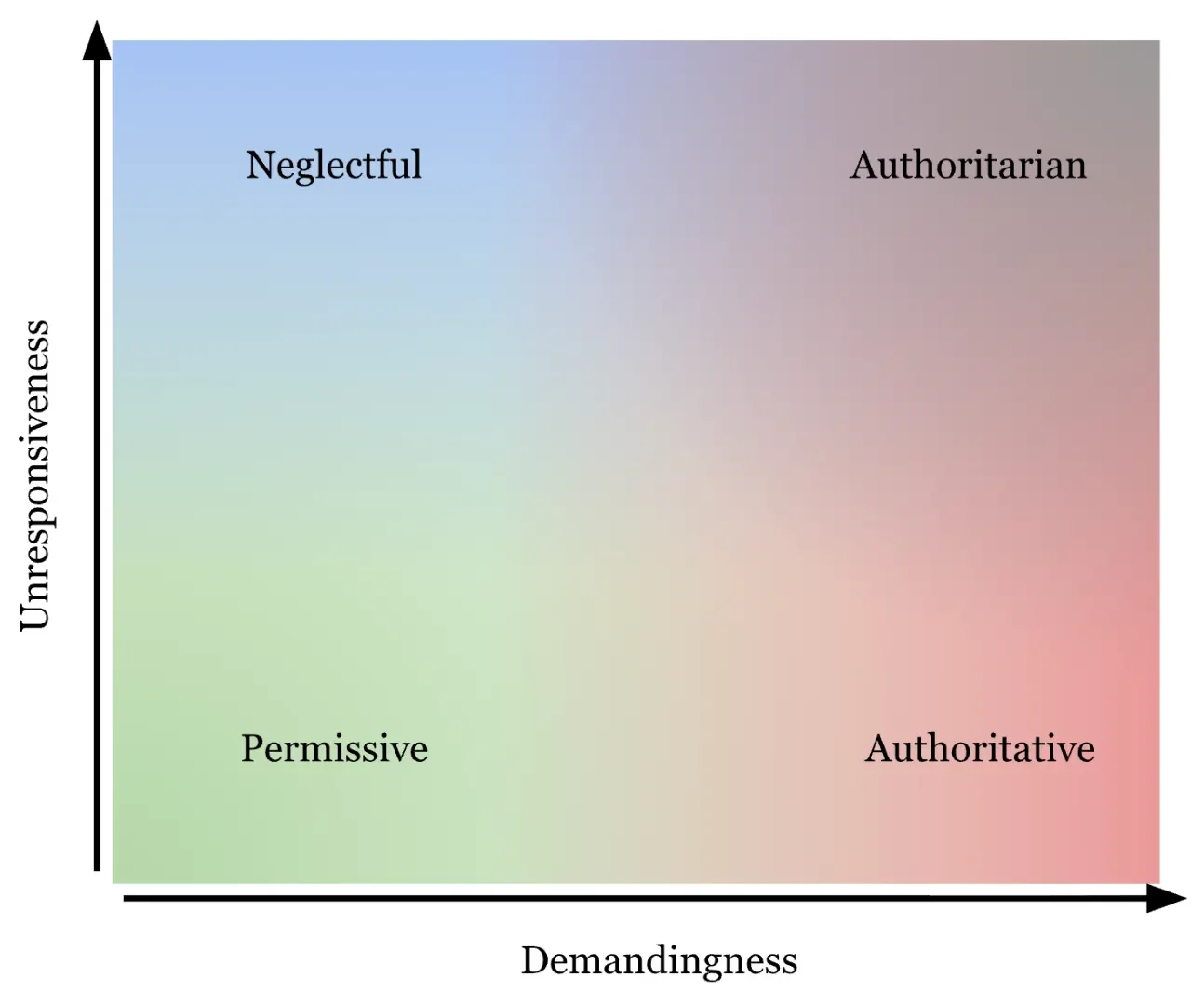
Permissive parents are indulgent and nonconfrontational. Their children skew socially skilled but impulsive.
Authoritarian parents are controlling, cold, and obedience-loving. Their children skew more disciplined, but withdrawn.
Authoritative parents are reasoned, and limit-observing. Their children skew confident, self-regulated but closed-minded.
Neglectful parents are uninvolved, tolerant, and their children skew free-spirited but chaotic.
The most cited gerontology study from 2020 identifies several dimensions that predict closeness between adult children and PCGs. These are:
Quality of original PCG-child relationship — This is the most powerful predictor. The Harvard Grant Study — one of the longest running longitudinal studies ever conducted — found that the warmth of childhood relationship with mothers matters long into adulthood: men who had warm childhood relationships with their mothers earned significantly more and were far less likely to develop dementia when old.
Geographic proximity — Visiting declines with distance.
Gender dyads — Across cultures, adult daughters more often meet and contact their parents than sons do, and emotional closeness and frequency of contact correlate with provision of functional support.
Value Consensus — Shared beliefs, political views, and life values are a surprisingly strong predictor of sustained closeness. Divergence in these — particularly around religion, politics, or parenting — is one of the most common drivers of adult estrangement. According to Pew Research Center, 64% of Americans report that family ties have weakened over the past two decades, in which there’s been a spike in intrafamily political deviation.
PCG’s financial freedom — Nearly half of parents whose child is completely financially independent report an excellent relationship with that child — among parents whose children are not financially independent, the shares are lower. Financial dependency introduces resentment in non-people pleasers. Power dynamic reversals erode closeness.
Timeline Misalignment — Children born to very young parents, or perceived as unplanned, show persistently lower closeness throughout life. One might be the middle child of 8 and just happen to be born at a time when parents were struggling. Whilst on the subject
Family Tradition — some families and some cultures more than others have a handed down directive to have PCG stay close to their charge and-or vice versa. Italy & Spain culturally celebrate large, multi-generational family structures. Research by the National Center for Biotechnology Information, shows that children and parents in these areas maintain exceptionally high rates of regular face-to-face contact into adulthood. Collectivist societies like Japan, Korea, and India promote filial piety and the enduring obligation to honour and support elders. Even before huge political speciation in the USA, PCG-child obligations were qualitatively the smallest of all nations. High divorce rates mean a significant percentage of children grow up in single-parent homes, which can reduce contact between children and their non-custodial parents.
Nth Child — Middle-born children perceive less closeness to parents and express less positive attitudes toward family than first-borns and last-borns, while showing more positive views toward friends. They occupy the least structurally distinct position, since the firstborn has primacy, while the lastborn has the “baby” role. The adaptive response is telling: rather than fighting for parental attention which, like resources (as per studies), is already allocated, middle children tend to invest laterally in peer relationships, friendships, and eventually romantic partnerships. Middle children tend to be mediators and are choosy about who they confide in, and are one of the most sexually faithful birth orders, highly motivated to make their marriages and families work [See — On Modelling and Anti-modelling]. Older mothers are especially likely to favour their last-born children. Parents are often more relaxed and less anxious by the time the last child arrives, producing a warmer, less pressured relational environment. According to the Resource Dilution Model, parental attention and physical resources are important in development, but are diluted as litter size increases. Older children often become functional co-parents, especially daughters. I’m looking at you, Leisl von Trapp. These roles drastically change the nature of vulnerability in the relationships in all directions. Firstborns, only children, and children with one sibling all score higher on tests of verbal ability than laterborns and children with multiple siblings and if causation rather than just correlation, this speaks to a cognitive as well as emotional effect of resource dilution.
A consistent finding across cultures is that PCGs see the relationship with their adult children in a more favourable light than do the children. This multiplied in adoptive dyads. Adoptive parents have often invested enormous emotional, financial, and sometimes bureaucratic effort to have the child, which can inflate their perception of closeness. The adoptee may not fully reciprocate that sense of investment.
The key to having a close ongoing relationship with parents then seems to be more than just a degree of parental vulnerability. But I argue that it’s the nature of that closeness that is defined by the prevalence of well-timed, voluntary or involuntary expressions of doubt, hurt, or dependence. Such scar-bearing sessions are a necessary condition for the re-envisagement of those who once were omnipotent, omniscient gatekeepers of freedoms into mortals of fallibility, limitation, and unsureness.
A growing global fluency in mental health means that parents are more likely to embed within tales of roasting marshmallows by the fire on camping holidays their horror stories about when they saw a person die for the first time in their tweenage years. But it’s not the stories about bad things happening that builds closeness but the reflection on how scared they felt at the time and continue to be with life’s current challenges. This parental self-disclosure is linked to adolescent trust and openness.
Sharing too many woes early on is one of the predictors for a child developing insecure attachment tendencies in later life. But never sharing those woes even once the PCG’s charge is emotionally developed is also suboptimal. American psychoanalyst Jessica Benjamin developed a theory of intersubjectivity and mutual recognition that draws together psychoanalysis and critical social theory. She argued that the self does not emerge from a one-way process of internalising the caregiver, but through a dynamic, two-way encounter between subjects — each of whom must recognise the other as an independent centre of consciousness. In her landmark work The Bonds of Love (1988), she examined how underlying the failure of mutual recognition is domination, arguing that adult master-slave dynamics are rooted in the earliest psychological negotiation between PCG and infant. It draws from German Philosopher George Hegel’s Dialectic of Recognition famously introduced in his Phenomenology of Spirit (1807), which framed the concept that human self-consciousness and freedom cannot be achieved in social isolation. Merely interacting with the physical world is not enough to develop self-awareness. When we see and are seen by another human, we realise they are an independent, autonomous being, and, in so doing, we appreciate that we in our comparableness can be thought of as the same.
All this to say that although we can sense that we might sense that a parent becomes a friend to their child gradually when they allow additional factors shine through unresponsiveness and demandingness such as supportiveness, bonhomie, curiosity, and excitement in sharing the best and worst about them.
The question awaits further research.
