
On Setting Boundaries
CAPTION
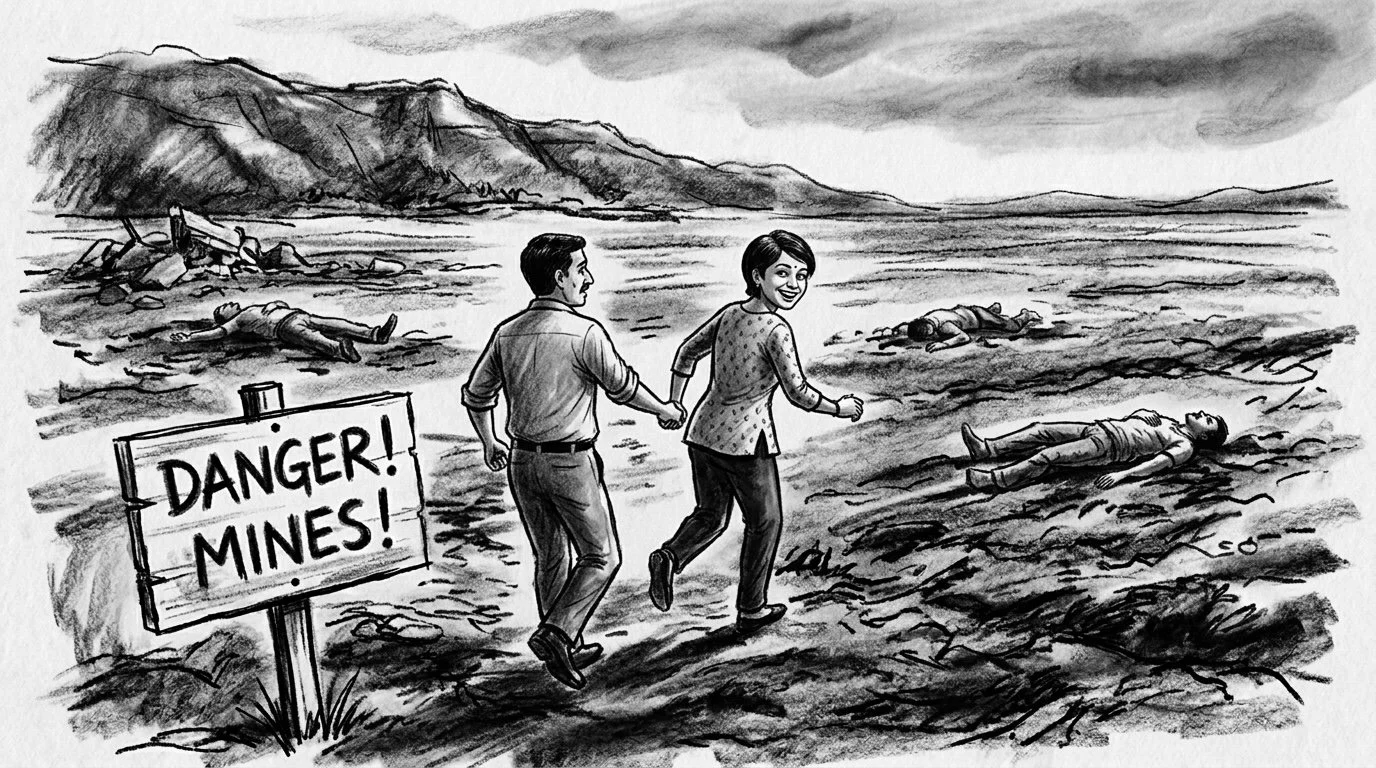
A good love might be worth a limb, but it’s not worth your life.
“Stop fucking around with my colleagues!” said Maya. As if my rumination wasn’t severe enough, I couldn’t make heads nor tails of this boundary. I’d spoken to only 4 or 5 of her colleagues ever despite the number of gigs I’d attended, couldn’t remember the content of any of those chats, and certainly since Maya was not exactly jumping to introduce me to them, I didn’t step around her.
Eventually this policy would turn to “don’t speak to my friends. I’m telling all my friends not to speak to you. They all know what you did.” This cascade of walls around my freedoms in my city, interacting with a culture that I love became so limiting in such a way that all routes were blocked by my respect for Maya’s words, even after she’d unceremoniously removed herself from my journey. And so she couldn’t have it both ways. She could tell me her preferences as my partner or she could disappear. She didn’t have the right to remove herself and then have even more say over what I do with my time, body, and energy. Besides, even if I did attend her shows, she would likely back down.
This whole debate with myself caused me to completely revamp my understanding of boundaries.
I asked a few friends what they’d set or heard before as examples of boundaries in non-mono relationships:
Do use our (my) bed for play without me.
Do not have sex with someone before we’ve discussed it.
Do not have sex with people I (don’t) know.
Do not set me up for sex with other people.
Do not have sex/ go home with other people when we are out together.
Do not have sex with your/ my colleagues.
Do not have sex with your/ my friends.
Do not have sex with someone more than X times a month.
Do not have sex with people not in our community.
Do not have one night stands.
Do not have unprotected sex.
Do not have sex with bad actors (be discerning).
And boundaries for any partnership:
Do not exchange romantic sentiments with others.
Hang out with me at least X times a week.
Invite me to key events first (weddings).
Have me as your emergency contact.
STI test once per month.
Be tidy.
Do at least 40% of chores like cleaning, laundry, shopping, washing up, cooking, dog walking, admin, etc.
Do not speak for my schedule (put events in my diary).
Do not speak to my family/ friends without me.
There’s no shame in this noble attempt to create a list of boundaries, for the prevailing popular understanding is that such dictates are how we teach people how we like to be treated. But as I said to my discarder after months of trying her way, “Don’t tell me, show me. Teach me by example, not through command.”
Let us now recolour and reclaim the dictionary entry of ‘boundary’ and make it more of a cushioned wall than a spike strip.
Boundary Theory emphasises that boundaries apply to influence one’s own behaviour, not other people’s. This means: “I promise myself that I will (not) speak to them” is a boundary, whereas “I promise myself that they will (not) speak to me” is an attempt to control. Poor phrasing of a boundary is actually more aggressive than a plea to influence others for one’s own sake. Scott Symes agrees: “some people who think they are setting boundaries are actually attempting to control someone else’s behaviour. When boundaries are used that way, they not only fail to do what’s intended but the people they’re attempting to control then resist become oppositional and defensive and the relationship disconnects. When boundaries are used inappropriately like this on the 2nd person, they become dysfunctional, creating resentment and power struggles.” To have a 1st person reflexive boundary is to have a plan which is more regulating than being held hostage by the acts of one’s partner. Boundaries are not threats, rules, demands but limits on one’s own behaviour in order to protect one’s self and the relationship, possibly from one’s own dysfunctional patterning.
Developing on this idea of making rules for someone else to follow, boundary settings must not create rules for allies as to how they treat the object of the relationship. Such rules are called indirect, rather than direct, a categorisation called Proxy. We must assume that our friends can make decisions about what company they keep and what treatment they can endure, unless we are literally and perhaps legally in charge of them.
The layering of these 2 categories of Reflexivity and Proxy presents us with examples of non-direct, non-1st person boundary setting which is over-reach at best and nothing short of emotional Imperialism at worst:
Personhood speaks to who the end ‘behaviour monitoring’ is for:
Subject (1st Person) is expected to watch their behaviour
Object (1st Person) is expected to be consistent in their behaviour.
Proxy speaks to whether a 3rd party is used to act as go-between to control the Object’s behaviour:
Direct — Involves only the Nominative and Accusative.
Indirect — Involves the Nominatives allies (the Datives)
In the example of buying of (not) buying gifts as a directly affective behaviour, we can pitch Personhood and Proxy against each other:
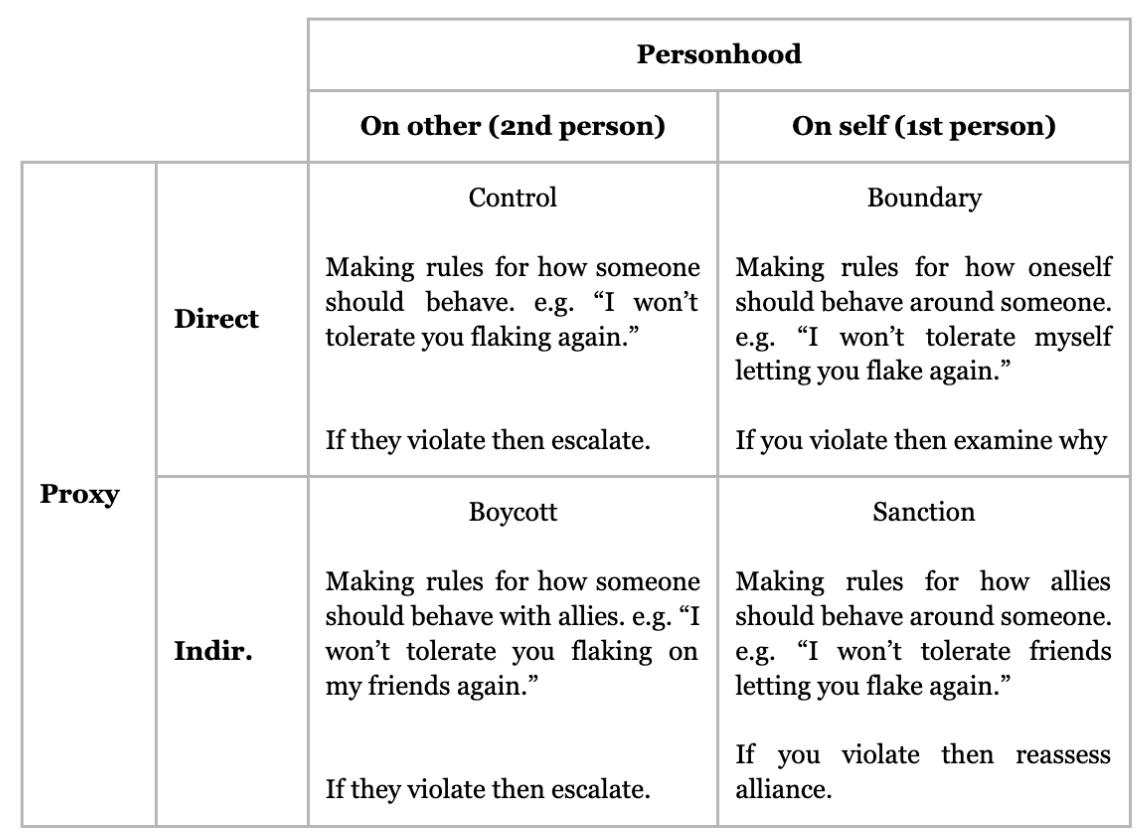
Non-Indirect Self Boundary setting is cleaner and more complete. It makes sure that we aren’t responsible for enforcing behaviour in the social circle around us, since Kierkegaard argued that responsibility is radically individual, not collective, although we like it when people have similar boundaries to us. Social circle selection is difficult but important.
John Stuart Mill’s Harm Principle said we only ought to limit someone’s freedom if they cause harm. If a person your friend sees does not harm you directly, you have no philosophical basis to dictate their associations. In non-monogamy circles, there’s a strong norm: “A boundary is something you do, not something you force someone else to do.” This is called ‘relationship autonomy’ or ‘non-policing’.
In conclusion, the NISB setting framework enables us to:
Prevent overreach
Clarify healthy autonomy in relationships
Reduce triangulation and enmeshment
Encourage adult emotional independence
Create a cleaner psychological map of what we actually control
Another way of categorising boundaries is by looking at its Application rules, that is to say, is it immediate or based on some event happening:
Proactive rules are absolute and always in practice — a personal mantra that is lived by.
Instigative rules are conditional on something happening, at which point a behaviour is switched on in response.
Desistive rules are conditional on something happening at which point a behaviour is switched off in response.
A final category provides a useful binary. Bounds describe whether we are looking out for too much or too little of a particular behaviour and the same terms can be conveyed in both maximum and minimum framing:
Maximums: An upper limit on some behaviour of one’s own or another’s. Such as:
Do not have unprotected sex.
Don’t sleep with my/ your exes. (indirect)
Don’t sleep with my/ your colleagues. (indirect)
Don’t slap my face during sex.
Don’t pressure me to hang out with your FWBs.
Some of these are more considerations rather than boundaries but you’d be surprised how many people fail to think about what needs mentioning, what affects them until it happens, and what actions of theirs affect their partner.
Minimums: A lower limit on some behaviour of one’s own or another’s. Such as:
Hang out with me X nights a week.
Go out with me X nights a month.
Stay connected to my friends/ parents. (indirect)
Rub my feet every day.
Tell me when you are upset with my behaviour.
It’s possible to pitch Application and Bounds against each other in a table and see how they interact:
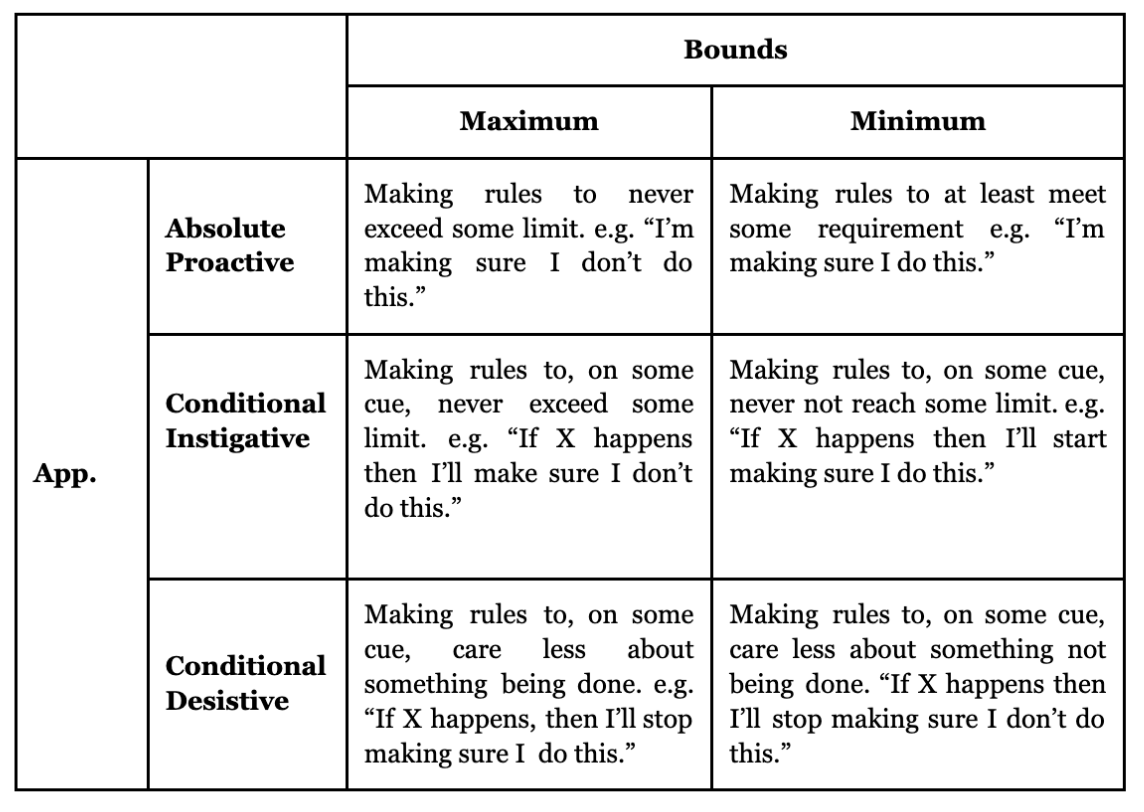
Want to hear what an instigative, 1st-person, indirect maximum example might be? Try: “Sophie, If David comes back after midnight then I don’t want you to speak to him.” A better boundary would be, “David, if you come back after midnight, then I will tell Sophie what you did.”
What about a desistive 2nd-person direct minimum? Try: “If you, David, drive to work rather than cycle then I’m going to stop abstaining from eating dessert.” That is a sustainable boundary.
Poor David.
Scott Symes says “boundaries exist to protect the space where love can thrive”, and so understanding boundaries is to arrive at a very exciting and progressive and accepting space where we take charge of ourselves, leaning on values and a rulebook to automate the safeguarding of our sensibilities, and show the world how we like to be treated, and possible how we should be treating each other.
